This isn't a package deal.

This is

your hairline.

FUE hair transplant in Delhi by Dr. Punam Singh, dermatologist and hair transplant surgeon

FUE hair transplant in New Delhi, planned by a dermatologist

For men and women losing their hairline, their crown or their confidence: an FUE hair transplant planned and performed by Dr. Punam Singh, dermatologist and hair transplant surgeon.

It starts with an examination of your scalp, not a quote on the phone. Before you decide, you know how many grafts you need, what result to expect and what the whole treatment will cost.

( 01 )

When hair loss starts to show

Receding hairline, thinning crown, bald patches

It begins quietly. A receding hairline at the temples, a crown that shows under the bathroom light, more hair on the pillow than there used to be.

So you change your parting, try another oil, keep a cap in the car and avoid photos taken from above. Every month the gap the camera finds gets a little wider.

That isn't vanity or bad luck. It is the sign that your hair loss needs a diagnosis, and that a permanent solution may now be possible.

Keep reading, because the right baldness treatment starts with knowing why your hair is falling, and a hair transplant is only one of the answers.

Book a hair consultation
( 02 )

Who a hair transplant is for

Hair loss that medicine alone can't fix?

A hair transplant suits men and women whose hair loss has settled into a pattern and who still have healthy hair at the back of the head to move. Patients come to Dr. Punam from Karol Bagh, Rajendra Nagar, Rajouri Garden, Janakpuri, Dwarka and across West Delhi.

For men:

A receding hairline, a thinning crown or a bald patch on top, usually male pattern baldness at stage 3 to 5. If the loss has slowed and your donor area is strong, an FUE hair transplant rebuilds the hairline and crown with your own hair, taken from the back of the head, where it resists the hormone behind pattern baldness.

For women:

A widening parting, a thin front or a high forehead. Hair loss in women is more often spread across the whole scalp, so many do better with medicine or PRP first. When the thinning sits in one area and the donor hair is good, a hair transplant for women can work well, and Dr. Punam tells you honestly which group you are in.

Different hairlines, same question:

Not how many grafts you can be sold, but what will actually work for your hair.

Let's find out.

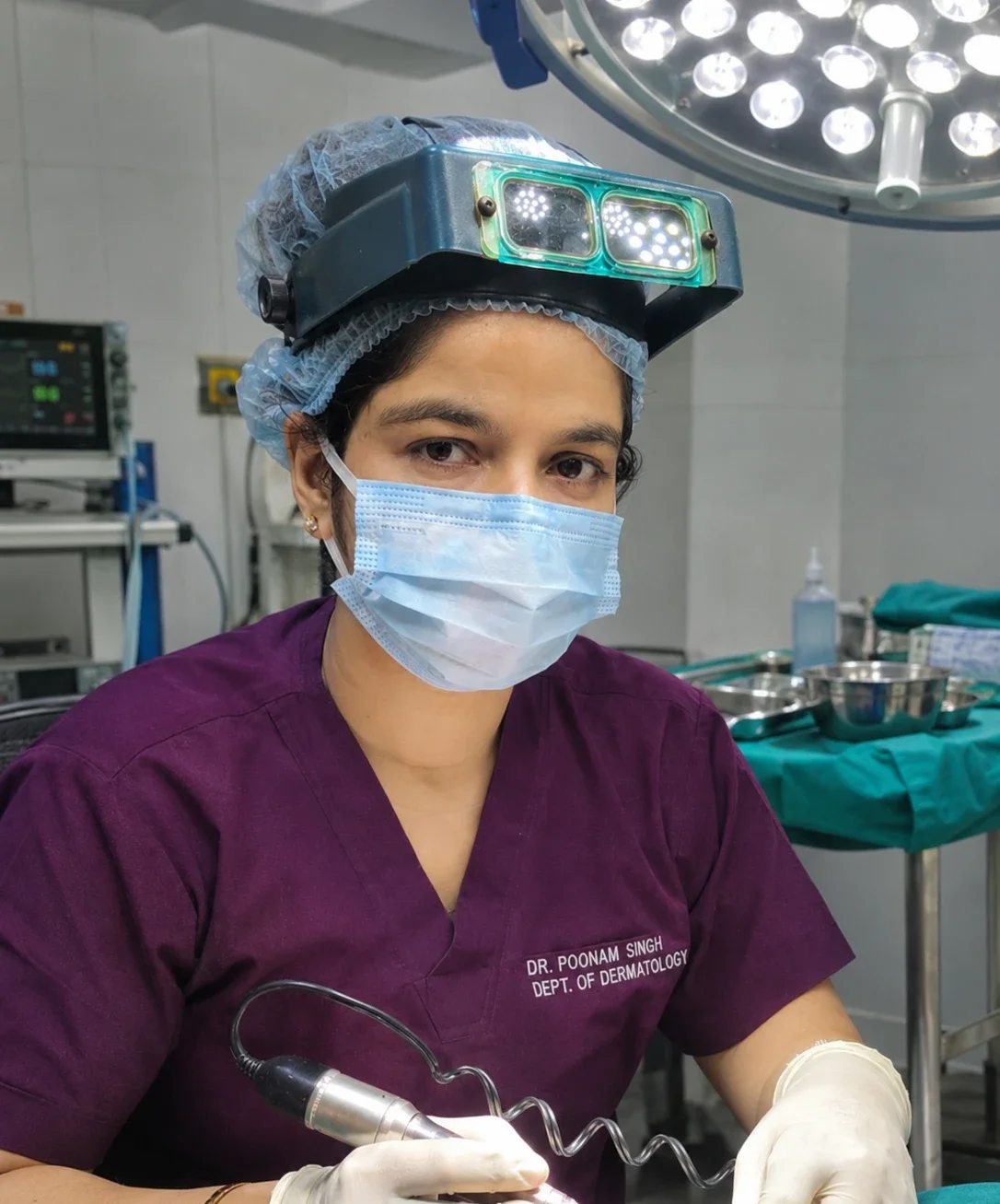
Dr. Punam Singh performing an FUE hair transplant, wearing surgical loupes

Your hair transplant starts with a scalp examination

One unhurried visit with Dr. Punam: trichoscopy of your scalp, the cause of your hair loss, the strength of your donor area and an honest graft estimate. You know whether a transplant is right for you before anything is booked.

Hair

( 04 )

How a hair transplant works

FUE (Follicular Unit Extraction) is a hair transplant method in which healthy hair roots are taken one by one from the back of your head and placed where your hair has thinned. There is no strip cut from the scalp and no stitches.

It is usually done in a single day under local anaesthesia, so you are awake and comfortable while it happens.

Here's how it works:

Planned. Precise. Natural.
  1. Plan.

    Your new hairline is drawn with you, to suit your face and your age, and the grafts are counted against what your donor area can safely give.

    01
  2. Numb.

    The scalp is numbed with local anaesthesia. You feel the first few injections; after that, most people listen to music, watch a film or doze.

    02
  3. Extract.

    Healthy hair roots are taken one by one from the back and sides of the head under magnification, leaving tiny dots that heal within days, not a long scar.

    03
  4. Implant.

    Each graft is placed at the angle and direction your own hair grows: finer and softer at the hairline, denser where the crown needs cover.

    04
  5. Recover.

    You go home the same day. Scabs fall in 7–10 days, the new hairs shed in weeks 2–6 (that is normal), growth shows from month 3–4 and the full result at 9–12 months.

    05

Most clinics count grafts. A dermatologist asks why your hair is falling.

A hair transplant is surgery on the skin of your scalp. Dr. Punam is a dermatologist with special training in dermato-surgery and hair transplantation, so the cause of your hair loss, the surgery and the medicines that protect your result are all handled by the same doctor.

Why patients choose
a dermatologist

One doctor.
Honest answers.

What you can expect from Dr. Punam

A hair transplant is not a one-day event. It is a plan: medicines to stop further loss, the transplant itself, and follow-ups until your result settles.

  • The cause first:

    Thyroid, iron, stress, dandruff or pattern baldness: the reason is found before anything is planned, because a transplant cannot fix hair loss that is still active.

  • A natural hairline:

    Drawn for your face and your age, not the lowest line possible, so it still looks right in ten and twenty years.

  • Safe graft numbers:

    Only as many grafts as your donor area can give without thinning the back of your head.

  • Protecting the rest:

    Transplanted hair stays, but the hair around it can keep thinning. Medicines or PRP to protect it are part of the plan.

  • Follow-up until it settles:

    Check-ups through the months that matter, until the full result shows at 9 to 12 months.

Dr. Punam Singh, dermatologist and hair transplant surgeon

No packages.
Just a plan.

( 05 )

What decides your cost:

No phone quotes. No hidden costs.

Hair transplant cost in Delhi depends on four things, and you get all four in writing after your scalp examination:

  • How many grafts:

    Most of the cost follows the graft count. A hairline needs far fewer grafts than a hairline and crown together, which is why grafts are counted at the examination, never guessed on the phone.

  • Your stage of hair loss:

    An early receding hairline (stage 2–3) is usually one sitting. Wider baldness (stage 5 and above) may need two, or a transplant combined with medicine.

  • Your donor area:

    Dense hair at the back of the head can give more grafts per sitting. Thinner donor hair means a smaller, safer plan, not a bigger bill.

  • What comes after:

    Medicines, PRP if it is advised and your follow-up visits are written into the plan, so nothing is added once you have said yes.

This starts with a scalp examination

Hair transplant consultation in New Delhi, for patients from Karol Bagh, West Delhi and Dwarka. Book yours.

Before you book, ask yourself

Is a hair transplant right for you?

Has your hair fall slowed down?

A hair transplant works best once pattern hair loss has settled. If your hair fall is still fast, hair fall treatment with medicine comes first, so the new hairline is never left standing alone.

Is there an age limit?

There is no upper age limit for a hair transplant if you are healthy. Before about 25 your pattern is still showing itself, so the plan usually starts with medicine.

Hair patch or hair transplant?

A hair patch or wig hides baldness every day and has to be replaced. A hair transplant is your own hair, permanent, washed and cut like the rest.

PRP, minoxidil or a transplant?

PRP and minoxidil protect the hair you still have. When they hold on to it but cannot bring back the hairline or crown, a hair transplant is the next step.

Dr. Punam Singh, dermatologist

Before you book, ask yourself

Is a hair transplant right for you?

Has your hair fall slowed down?

A hair transplant works best once pattern hair loss has settled. If your hair fall is still fast, hair fall treatment with medicine comes first, so the new hairline is never left standing alone.

Is there an age limit?

There is no upper age limit for a hair transplant if you are healthy. Before about 25 your pattern is still showing itself, so the plan usually starts with medicine.

Hair patch or hair transplant?

A hair patch or wig hides baldness every day and has to be replaced. A hair transplant is your own hair, permanent, washed and cut like the rest.

PRP, minoxidil or a transplant?

PRP and minoxidil protect the hair you still have. When they hold on to it but cannot bring back the hairline or crown, a hair transplant is the next step.

If you answered yes,

a hair transplant in Delhi may be right for you. One scalp examination with Dr. Punam will tell you for sure.

( 07 )

Dr. Punam Singh

  • Dermatologist for skin, hair & nails
  • Trained in dermato-surgery & hair transplantation
  • Botox, fillers & thread lifts
  • Vitiligo surgery
  • Lasers, peels & PRP
  • Leprosy & confidential STI care

Frequently asked questions

The cost of a hair transplant in Delhi depends mainly on how many grafts you need, then on your stage of hair loss, the strength of your donor area and the follow-up care. Dr. Punam counts the grafts at your scalp examination and gives you the full cost in writing before you decide, with no hidden charges later.

Yes, the transplanted hair usually is. It is taken from the back of the head, where hair roots resist DHT, the hormone behind pattern baldness, so it keeps growing in its new place. The hair you already have can still thin with time, which is why medicine to protect it is part of the plan.

Done by a trained doctor under local anaesthesia, a hair transplant is a safe, minor procedure. Common side effects are short-lived: swelling of the forehead for a few days, small scabs, itching and temporary shedding of the new hairs. Infection and visible scarring are uncommon when the aftercare is followed.

Only the first few numbing injections are felt. After that the scalp is numb, and most people listen to music, watch a film or doze during the procedure. Mild soreness for a day or two afterwards is usually managed with simple painkillers.

In weeks 2 to 6 the transplanted hairs shed, which is normal. New growth starts around months 3 to 4, about half the result shows by month 6, and the full result is seen at 9 to 12 months; the crown can take up to 18 months.

It depends on your stage of baldness and the area to cover. As a rough guide, rebuilding a receding hairline (stage 2 to 3) often needs about 1,000 to 2,000 grafts, and stage 4 to 5 more. Your exact number is counted at the examination, against what your donor area can safely give.

There is no fixed upper age limit if you are healthy. Most doctors prefer to wait until about 25, because before then the pattern of hair loss is still showing itself; younger patients usually start with medicine.

A hair patch or wig covers baldness but has to be worn, cleaned and replaced for life. A hair transplant uses your own hair, so it grows, can be cut and washed normally, and needs no upkeep once it has settled. For most people with stable hair loss, a transplant is the long-term answer.

PRP and medicines like minoxidil help the hair you still have grow thicker and slow further loss; they cannot grow hair where the roots are gone. If there are bald areas, a hair transplant fills them, and PRP or medicine is often used alongside it to protect the rest.

Yes, when the thinning is in one area, such as a high forehead or a thin front, and the donor hair is good. Hair loss in women is more often spread across the whole scalp, so many women do better with medicine or PRP first; the examination tells you which group you are in.

Shock loss is temporary shedding of hair after the procedure, of the new grafts and sometimes of nearby hair. It usually happens in weeks 2 to 6 and grows back over the following months. It is a normal part of healing, not a sign that the transplant has failed.

Most people return to office work within 3 to 5 days. The small scabs fall off in 7 to 10 days, and heavy exercise, swimming and strong sun are avoided for about two weeks. Dr. Punam gives you day-by-day aftercare instructions to take home.

Yes. Patients come to Dr. Punam for hair transplant and hair loss treatment from Karol Bagh, Rajendra Nagar, Patel Nagar, Rajouri Garden, Janakpuri, Dwarka and across West Delhi. Send an enquiry and the clinic team calls you back to fix a time.

Your hairline, planned with you.

Book a hair consultation
Book a consultation